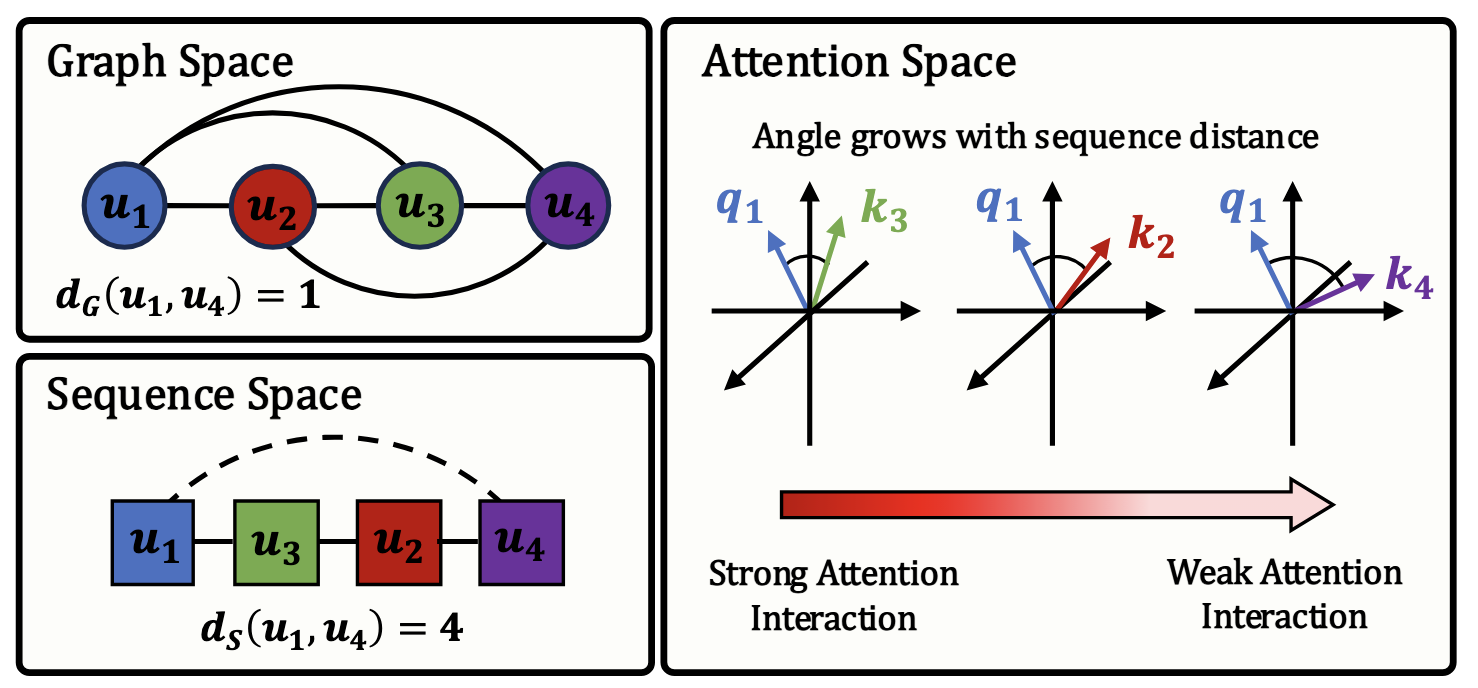
Large Language Models (LLMs) have recently shown promise for directly reasoning over Text-Attributed Graphs (TAGs) by leveraging their vast pretrained knowledge. However, applying LLMs to graph data requires linearizing their structure into token sequences, introducing distortion rooted in the graph bandwidth problem. While this distortion is known to degrade performance, it is often attributed to prompt design or model scale, leaving the underlying mechanism unclear. In this work, we characterize how performance degradation arises due to the LLM’s positional biases (e.g. Rotary Positional Embeddings), suppressing attention between graph-adjacent nodes when they are far apart in the sequence, even when sufficient semantic information is present. This insight shifts the focus of LLM-based graph reasoning from prompt engineering and scaling to intervening on the attention mechanism. Motivated by this, we propose Graph-aligned Language Attention (GaLA), a lightweight, inference-time attention modification that softly injects graph structure into LLM. GaLA biases the LLM’s attention toward the graph structure while preserving sequential inductive biases, effectively interpolating between LLMs and graph transformers without training. Across multiple TAG benchmarks, GaLA improves zero-shot performance with minimal overhead, demonstrating that improving attention alignment is valuable for LLM-based graph reasoning.
Back
Formalizing and Mitigating Structural Distortion in LLM Attention for Zero-Shot Graph Reasoning
August 9, 2026
|
KDD 2026
Graphs & Relational Learning